Sunday Best – February 18. 2024
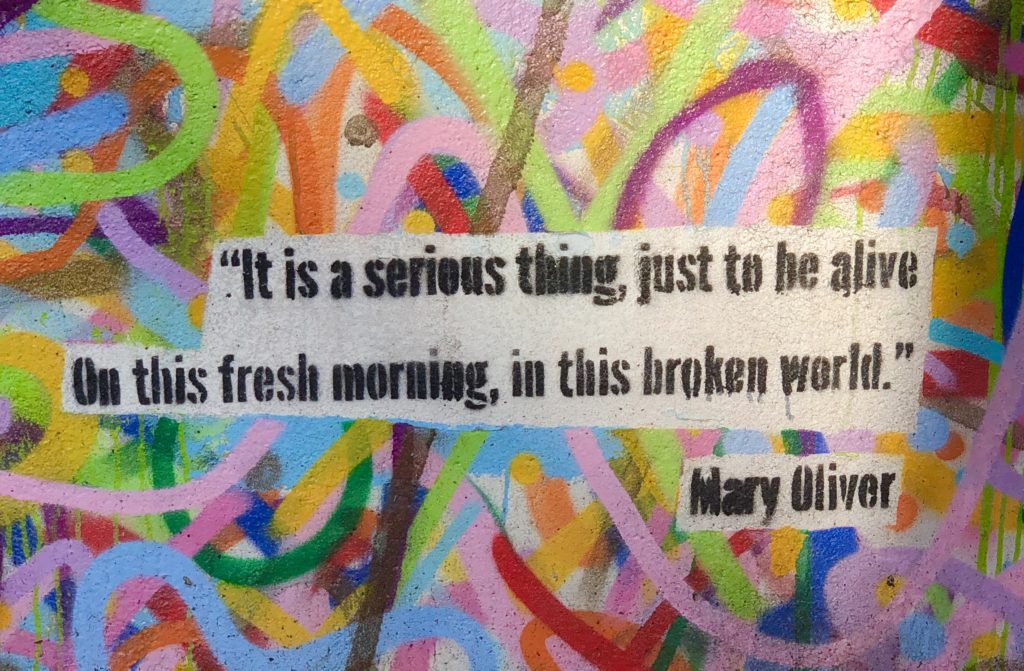
Friends, I am happily unplugged today, and wishing you a pocket of quiet reflection as well. Here with a similar and more completely formed wish is Invitation from Mary Oliver’s Red Bird :
Oh do you have time
to linger
for just a little while
out of your busy
and very important day
for the goldfinches
that have gathered
in a field of thistles
for a musical battle,
to see who can sing
the highest note,
or the lowest,
or the most expressive of mirth,
or the most tender?
Their strong, blunt beaks
drink the air
as they strive
melodiously
not for your sake
and not for mine
and not for the sake of winning
but for sheer delight and gratitude –
believe us, they say,
it is a serious thing
just to be alive
on this fresh morning
in this broken world.
I beg of you,
do not walk by
without pausing
to attend to this
rather ridiculous performance.
It could mean something.
It could mean everything.
It could be what Rilke meant, when he wrote:
You must change your life.
Sunday Best – February 11, 2024
Not all those who wander are lost.
I heard a terrific academic presentation this week which made the point that conversation is a highly advanced technology, full of signals like facial expressions, pauses and responses, and pacing and tone of language. This is one reason I still listen to corporate executives on earnings calls instead of just reading the transcripts, and why it is so wonderful to hear the voices of our loved ones, no matter how frequently our texts shuttle back and forth.
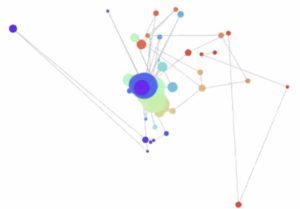
Another point the scientists made is that conversation is anything but linear – as shown in the graphic depiction above, it zooms hither and yon and loops around whatever the central subject is – and not due to inefficiency. The twists and turns are sometimes the most important part of the discussion.
Dear ones, in our busy world,
full of checklists and straight lines,
let’s leave some space
for the wandering
that brings us together.
This quote is from JRR Tolkien in Lord of the Rings, “The Riddle of Strider,” a poem left by Gandalf to help Frodo.
All that is gold does not glitter,
Not all those who wander are lost;
The old that is strong does not wither,
Deep roots are not reached by the frost.
From the ashes a fire shall be woken,
A light from the shadows shall spring;
Renewed shall be blade that was broken,
The crownless again shall be king.
The graphic and research referenced above are from Dr. Thalia Wheatley, SFI & Dartmouth.
Sunday Best – February 4, 2024

When I visited Japan last fall, I kept having flashbacks to my 20-year old self, the person I’d been when I first traveled there. Every Proustian taste and every recollected phrase pulled me into a strange parallel universe, where I was simultaneously then and now.
Then I happened upon this passage from Zora Neale Hurston, where Janie is reconnecting with her own self after a long separation.
Years ago, she had told her girl self to wait for her in the looking glass. It had been a long time since she remembered. Perhaps she’d better look… She took careful stock of herself, then combed her hair and tied it back up again. Then she starched and ironed her face, forming it into just what people wanted to see.
Friends, we’ve all left little bits and pieces along the pathways of our lives, breadcrumbs that we might follow to mark the way back to ourselves.
What might we find if we gathered them up,
re-membering as we go?
The time will come
when, with elation,
you will greet yourself arriving
at your own door, in your own mirror
and each will smile at the other’s welcome,
and say, sit here. Eat.
You will love again the stranger who was your self.
Give wine. Give bread, Give back your heart
to itself, to the stranger who has loved you
all your life, whom you ignored
for another, who knows you by heart.
Take down the love letters from the bookshelf
the photographs, the desperate notes,
peel your own image from the mirror.
Sit. Feast on your life.
– Derek Walcott, Love after Love
Sunday Best – January 28, 2024
Putting a name on a cloud doesn’t do anything to it – it doesn’t separate the cloud from the sky. – Alan Watts
This week at work I noticed so many efforts to name the clouds around us. A analyst struggled to create market estimates for a new technology that is just barely beginning to emerge. There were delays in deployment of a stunningly complex reporting protocol, one seemingly based on a premise that to name is to control. An executive tried to explain that their three different product lines were only separate on our spreadsheets, since in the real world they are all intertwined.
I truly love analysis, in almost every form. It brings a sense of agency in an uncertain world – and occasionally, real insight. The best part is when you can add a great new piece to the rest of the puzzle, and step back to take in the view.
However.
Dear ones,
perhaps,
sometimes,
instead of naming each cloud and trying to fix it in place,
we could just appreciate the sky.
Sunday Best – January 21, 2024

My college calculus professor used to say, “I know you got the answer right, but do you grok it?” He wanted us to feel the math in a way that went beyond the mechanics of the equations.
Then in a Buddhist retreat years ago, our teacher spent some time explaining the tiny spark of clarity that might result from our meditation. When he asked if we understood, everyone’s heads bobbed eagerly. Sadly he replied, “Oh, that’s too bad. If you think you understand it from my words, then I have explained it all wrong.”
And just this week, another wise teacher concluded an extended set of strategic discussions by imploring those of us in attendance, “Please, please, don’t explain it. The more explanation, the more misunderstanding.”
In each of these instances, we were trying to explore an idea that could only fully arise within the doing and the being – a concept that words could outline but never animate.
Friends, I hope we all can aim to become better communicators, clear of sight and full of heart and crisp of mind.
And beyond all that, whether in calculus or consciousness or community, may we save some space for the living that lies beyond language,
these deep wells of knowing where glimmers on the surface barely begin to reflect the splendors below.