Sunday Best – March 22, 2026
We are continually shaped by the forces of coincidence.
– Paul Auster
Sometimes it seems like the world is conspiring against us, in ways big and small. The flight is mysteriously delayed, there is inexplicable snow despite a sunny forecast, the news headlines stretch the bounds of bear-ability… On any given day, it’s not hard to stack up the challenges that come our way. Just this past week, I encountered all of the items above, and then some.
Also.
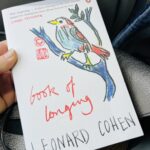
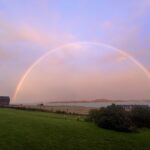
Two dear friends were surprisingly in the same faraway city as me, and a third was heading to a remote island retreat just as I was departing. In the charity shop of a tiny seaside town, a recently recommended book practically leapt into my hands, from is spot amongst tattered 1980’s cookbooks. A gorgeous stag perched right alongside the road as our bus passed by. A huge rainbow shone on an ancient Celtic abbey as the sun set on St Patrick’s Day.
I mean, come on.
Dear ones, the bad luck can smack us right in the face.
Let’s let the good luck do the same.
Sunday Best – March 15, 2026
Dear friends, I am happily unplugged today, so I send you this wise and generous poem from Padraig O’Tuama, from the volume Readings from the Book of Exile.
Dear ones, may we be gentle with our selves.
Friends, welcome to the night, and welcome to the day.
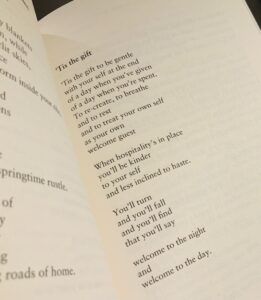
‘TIS THE GIFT
’Tis the gift to be gentle
with your self at the end
of a day when you’ve given
of a day when you’re spent.
To re-create, to breathe,
and to rest
and to treat your own self
as your own
welcome guest
When hospitality’s in place
you’ll be kinder
to your self
and less inclined to haste.
You’ll turn
and you’ll fall
and you’ll find
that you’ll say
welcome to the night
and
welcome to the day.
Sunday Best – March 8, 2026
At a panel discussion last year, I was asked where I saw the “tip of the spear,” the next battle to be fought – presumably with a righteous goal in mind. It was not until this question was posed that I realized my complete disinterest in it, even dismay. I was yearning for someone to ask, What is newly possible? Where are new connections forming? What is worth seeding for the future, even if we are not here to see the sprouting or the fruiting?
Instead I was being asked – again, still, only – to name adversaries. Enemies.
This all came whooshing back to me at a terrific public conversation this weekend between Nora Bateson, Bayo Akomolafe, and Alex Forrester, through the Schumacher Center for a New Economics. One word that arose in discussion was “insidious” – where the particular danger is not just that something is harmful, but that it is sneakily so, twisting and growing and gaining strength before it is recognized.
Friends, what is the opposite of insidious? Multiple thesaurus entries say “harmless,” but that’s not enough – surely the opposite of insidious is not just neutral, but something wonderfully positive. If poisonous tendrils can proliferate underground, so can generative mycelium.
Dear ones, what are the subtle sneaky awesome things that we can nurture, gathering elegance and beauty and strength along the way?
We might not have tidy answers, and we might still be developing the methods. But we do know that spears alone are insufficient. We need the shovels, too.
Sunday Best – March 1, 2026
I recently reconnected with the work of Liliana Porter, an artist who I first noticed years ago at an auction for the terrific MassArt. In a recent interview, she shows off a toy monkey with cymbals, the kind that can drive you nuts in under 30 seconds. I was puzzled by Liliana’s obvious affection for this annoying toy, as she wound him up to full clanging effect. Then she explained that she loved him especially because…. “When he stops, the silence is amazing.”
It is easy for me to name the clanging monkeys in my life, both external and internal. But harder to notice the amazing silences.
Dear ones, where do we find spaces and pauses, however delayed, however temporary?
If we notice, some of them might be amazing.
A recent mini-documentary from MoMA on Liliana Porter can be found here.
And a NYTimes feature on her work from a few years back can be found here.
MassArt (Massachusetts College of Art & Design) is the only independent public art college in the US, and their spring auction is a treasure trove.
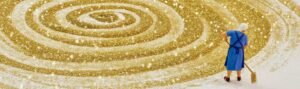
Detail from Liliana Porter’s The Task, 2024.
Sunday Best – February 22, 2026
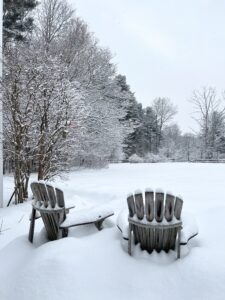
After 24 hours of watching still more snow fall, even my hibernation-loving self needed to get outside. I tramped around the field in my snowshoes, sinking deep with every step. I trimmed some forsythia to bring inside. I stood on top of one of the snow plow mounds to admire the view from waaaay up there.
Then, I tried to stomp out the shape of a giant snowflake in a flat part of the field. One branch of the flake, pretty good. Two branches, zipping right along. On the third branch I turned, cris crossed the snowshoes, and fell flat on my back, waving my arms like a turtle who can’t flip over.
My first response was embarrassment over my lack of prowess, and annoyance at the now-flawed design. My creative vision was ruined! And maybe more importantly, my backside was cold and wet. (Then again, who is actually skilled at making giant snowshoe pictures? I blame the Olympics, making all that sliding around look graceful and natural.)
Suddenly I saw myself from above, helplessly wriggling about in the middle of all that whiteness, and with the next breath I was laughing and laughing. I made a little snow angel, fought my way upright, and was quickly hot cocoa-bound (which of course is the main point of going outdoors in winter anyway).
Dear ones, may we find new ways to play.
May we cling a little less tightly to winning.
May we savor the sweetness that follows.