Sunday Best – July 20, 2025
Some Saturdays are stormy or steamy, or so full of obligation that they might as well be Mondays.
But then comes a clear and fine and free one, at long last, reminding us of all possible glories.
We could read in a hammock, or hike up a hill.
We could tend to a garden or a pet or a child or ourselves.
We could draw or sing or dance or think.
We could drink a pink drink.
Truth be told, most of those things could happen on Monday too.
Dear ones, the stormy times will come unbidden,
so when we can,
let’s delight in the spirit of sunny Saturdays,
all the week through.
Sunday Best – July 13, 2025
I’ve been continuing to revisit the extraordinary Rilke translations of Joanna Macy and Anita Barrows lately, a perfect balm and motivator for our topsy-turvy world. Whether scanning the latest headlines, witnessing a summer thunderstorm, or navigating a flowing river, these words ring true.
God speaks to each of us as he makes us,
then walks with us silently out of the night.These are the words we dimly hear:
You, sent out beyond your recall,
go to the limits of your longing.
Embody me.Flare up like flame
and make big shadows I can move in.Let everything happen to you: beauty and terror.
Just keep going. No feeling is final.
Don’t let yourself lose me.Nearby is the country they call life.
You will know it by its seriousness.Give me your hand.
Sunday Best – July 6, 2025
This past week I was lucky to be surrounded by some caring, committed humans who were all seeking reflection and connection and maybe, possibly, meaning. In one conversation a mention was made of poet Joy Harjo’s comment that in tumultuous times – which may indeed be all times – we are called to fly a little.
On a long desert road trip that followed, I found myself singing along to top hits of the 80’s (obviously), and wondering where all of the saxophones in pop music have gone. (Woodwinds 4-eva!)
Lo and behold, these two dots are connected.
The saxophone is so human. Its tendency is to be rowdy, edgy, talk too loud, bump into people, say the wrong words at the wrong time, but then you take a breath, all the way from the center of the Earth, and blow. All that heartache is forgiven. All that love we humans carry makes a sweet, deep sound, and we fly a little.
– Joy Harjo, in conversation with Krista Tippett
Dear ones, whether our lives feel steady or swirly,
whether through saxophone or spirit,
may we all find a way
to fly a little.
Sunday Best – June 29, 2025
It’s very interesting to me,
this dual citizenship
between the stars and the stones.
I’ve just finished the quietly glorious Aflame by Pico Iyer, where he references this comment from the abbess of a Zen center. “You can’t live on Everest – you have to come back and do the dishes.” The view from the mountaintop might be sparkly and splendid, but it’s in the day to day routine of living – sometimes boring, sometimes downright tedious – that the deepest roots can take hold.
I’m most intrigued by the glimmers we get that unite the stars and stones. A quiet birthday spent with loved ones. A pat on the knee during a bumpy flight. A flash of cardinal in the evergreen.
Dear ones, whether today is starry or stony, let’s rest safe in the knowledge that they are infinitely, intricately intertwined.
Sunday Best — June 22, 2025
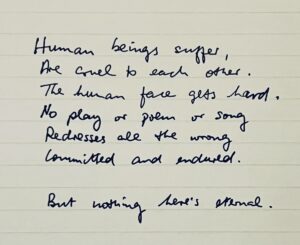
One of my dear friends has a custom of sending handwritten postcards, and each one arrives as an unexpected delight. There’s something so tangible and personal about handwriting, and increasingly rare in our digitized world.
This week I visited an exhibit of Seamus Heaney’s work, full of texts so familiar they feel like my hometown. And yet, seeing such well-known words in his own hand brought a spark of tears to my eyes. There’s a directness to ink on paper that collapses time and space, and opens up some more essential connection.
Dear ones, we are not all poets, or artists, or even correspondents. Sometimes all we can offer is a quick text or a glance across the table.
But however we can, let’s say the things that keep us just a little softer.
Let’s keep the further shore in sight.
Excerpt from The Cure at Troy,
by Seamus Heaney
Human beings suffer
They torture one another,
They get hurt and get hard.
No poem or play or song
Can fully right a wrong
Inflicted and endured.
The innocent in gaols
Beat on their bars together.
A hunger-striker’s father
Stands in the graveyard dumb.
The police widow in veils
Faints at the funeral home.
History says, Don’t hope
On this side of the grave…
But then, once in a lifetime
The longed-for tidal wave
Of justice can rise up,
And hope and history rhyme.
So hope for a great sea-change
On the far side of revenge.
Believe that a further shore
Is reachable from here.
Believe in miracles
And cures and healing wells.
Call miracle self-healing:
The utter, self-revealing
Double-take of feeling.
If there’s fire on the mountain
Or lightning and storm
And a god speaks from the sky
That means someone is hearing
The outcry and the birth-cry
Of new life at its term.
It means once in a lifetime
That justice can rise up
And hope and history rhyme.