Sunday Best – February 16, 2025
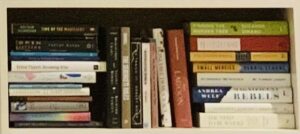
What a total delight to find a word that uniquely expresses an exact and complex concept. Schadenfreude, for example. Or drizzle.
Tsundoku is one of my favorite words in Japanese. It describes a big pile of books that have not been read. It’s not hoarding, or collecting… it starts with the clear intention to read, and the pile of unread volumes is the natural outcome, not a goal unto itself.
More precisely, it’s “not yet read” books, because the intention persists. “Unread” is only a temporary state.
There is no failure.
There is no delay.
There is no waste.
There is only true intention,
and a pile of possibility.
Dear ones, whatever is undone in our lives,
perhaps we are preparing.
Perhaps the “un” is false.
Perhaps it is just
not yet.
Sunday Best – February 9, 2025
“A friend may well be reckoned the masterpiece of nature.”
– Emerson
On Monday a friend helped me see a higher self when I was cloudy.
On Tuesday a friend taught me something I did not know.
On Wednesday a friend asked after my loved ones.
On Thursday a friend shared tiki drinks and dumplings.
On Friday a friend offered grace under pressure.
Dear ones,
our friends offer so much,
often unbidden, and un-thanked.
Simple.
Magnificent.
May we endeavor to deserve them.
Sunday Best – February 2, 2025

“You overestimate your achievements
and underestimate your blessings.”
– Severance TV show
I am not sure what this quote means within the context of a dystopian drama, but I do know how valuable it can be to count our blessings.
Some are mega, like the love of friends and family or the solace of the woods and mountains.
Some are micro, like a sunbeam through the window or a perfect line of poetry.
Dear ones, even in our darkest times,
our blessings are great indeed.
May we awaken to their presence.
May we revel in their power.
Sunday Best – January 26, 2025

Friends, I bring glad tidings! It turns out there is some great utility to social media. I learned from a friend’s post that the Boston Symphony was about to finish its sweeping production of Beethoven’s symphonies. Lo and behold, the last ticket in the last section for the last performance was waiting for me, and now the echoes of the extraordinary Ode to Joy are ringing in my ears, and my eyes are all misty from the powerful emotions it stirs.
This in turn brings to mind the poem below, one I originally encountered through the wonderful Elizabeth Lesser at the Omega Institute.
ODE TO THE JOYFUL ONES, BY THOMAS LUX
Shield your joyful ones.
– from an Anglican prayer
That they walk, even stumble, among us is reason
to praise them, or protect them—even the sound
of a lead slug dropped on a lead plate, even that, for them,
is music. Because they bring laughter’s
brief amnesia. Because they stand,
talking, taking pleasure in others,
with their hands on the shoulders of strangers
and the shoulders of each other.
Because you don’t have to tell them to walk toward the light.
Because if there are two pork chops
they will serve you the better one.
Because they will give you the crutch off their backs.
Because when there are two of them together
their shining fills the room.
Because you don’t have to tell them to walk toward the light.
Dear ones, whether percussion or poetry or pork chops,
I wish us joy.
Sunday Best – January 19, 2025
The Church is what we do next.
It is rare that a line from a movie stops me in my tracks. Of course, that could be because the Netflix algorithm has figured out that while I theoretically admire brainy documentaries, I usually end up watching rom coms from the 90’s that have not aged very well.
But this week I upgraded my viewing habits, and was richly rewarded.
In the middle of the film Conclave, where the traditions of the Catholic Church are on highest display, one character declares, “The Church is not tradition. The Church is not the past. The Church is what we do next.”
Ohhh, friends, this is the question, in settings both small and grand.
Yes, we can reflect on history.
Yes, we can question the present.
(And we can try to BE present while we’re at it).
But the only decision available to us,
perpetually and blessedly so,
is this one.
What will we do next?