Sunday Best – January 26, 2025

Friends, I bring glad tidings! It turns out there is some great utility to social media. I learned from a friend’s post that the Boston Symphony was about to finish its sweeping production of Beethoven’s symphonies. Lo and behold, the last ticket in the last section for the last performance was waiting for me, and now the echoes of the extraordinary Ode to Joy are ringing in my ears, and my eyes are all misty from the powerful emotions it stirs.
This in turn brings to mind the poem below, one I originally encountered through the wonderful Elizabeth Lesser at the Omega Institute.
ODE TO THE JOYFUL ONES, BY THOMAS LUX
Shield your joyful ones.
– from an Anglican prayer
That they walk, even stumble, among us is reason
to praise them, or protect them—even the sound
of a lead slug dropped on a lead plate, even that, for them,
is music. Because they bring laughter’s
brief amnesia. Because they stand,
talking, taking pleasure in others,
with their hands on the shoulders of strangers
and the shoulders of each other.
Because you don’t have to tell them to walk toward the light.
Because if there are two pork chops
they will serve you the better one.
Because they will give you the crutch off their backs.
Because when there are two of them together
their shining fills the room.
Because you don’t have to tell them to walk toward the light.
Dear ones, whether percussion or poetry or pork chops,
I wish us joy.
Sunday Best – January 19, 2025
The Church is what we do next.
It is rare that a line from a movie stops me in my tracks. Of course, that could be because the Netflix algorithm has figured out that while I theoretically admire brainy documentaries, I usually end up watching rom coms from the 90’s that have not aged very well.
But this week I upgraded my viewing habits, and was richly rewarded.
In the middle of the film Conclave, where the traditions of the Catholic Church are on highest display, one character declares, “The Church is not tradition. The Church is not the past. The Church is what we do next.”
Ohhh, friends, this is the question, in settings both small and grand.
Yes, we can reflect on history.
Yes, we can question the present.
(And we can try to BE present while we’re at it).
But the only decision available to us,
perpetually and blessedly so,
is this one.
What will we do next?
Sunday Best – January 12, 2025

This week is marked by losses. Our nation honored the life of President Carter. I learned of the passing of two more dear souls, one very young. And the fiery news from the city of angels continues, with its unfathomable destruction and sorrow.
Amidst all of this heartbreak, I hear echoes of my friend and mentor Susan Davis, one of those who recently passed. When I finished Divinity School, we were discussing some grand and serious ambitions together, when Susan noted with laughter, “you know, even though you’re now officially qualified, no one wants to hear your sermon. No one wants to hear any sermon! You have to throw a better party.”
It might seem incongruous or disrespectful to speak of parties and pain in the same paragraph. But I think that was Susan’s point. All of life was a party to her, and she said so, often.
Dear ones, the pain will come to each of us, unbidden and unexpected and unwelcome.
And so when we can, while we can, we gather, and celebrate, and commiserate, and laugh. We fill up on kinship, to help us through the valleys.
The party is not that every day is full of balloons and streamers.
It’s that every day is its own prize.
Precious. Priceless.

Photo from ABCNews.
Some might recall that I spent many years volunteering with Habitat for Humanity, and was fortunate to meet the Carters several times. I wrote of what I learned from President Carter on a trip to Plains, GA here.
Sunday Best – January 5, 2025
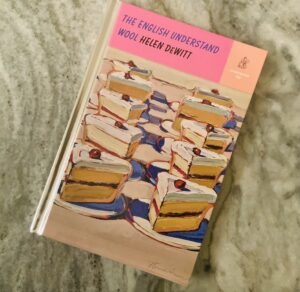
I started the day yesterday with a glorious pocket of reading time, diving into Helen DeWitt’s captivating book, The English Understand Wool.
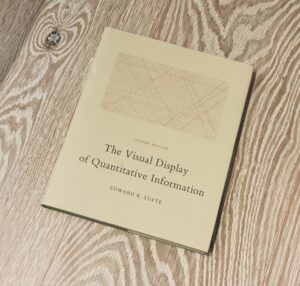
The story somehow managed to present a calculated, logical point of view as warmly human and victorious, triumphing over a pack of wolves in sheep’s clothing. This alone is worthy of the highest recommendation, but at the end of the volume there was also a postscript that referenced Edward Tufte – yes THAT Tufte, he who proclaims “the presentation of data is a moral act,” and whose beautiful dense publications powerfully prove this point.
It turns out that Tufte took out a second mortgage on his home in order to publish the exacting type of book that he knew was required to do justice to his topic – a part of history I had never known, and a theme echoed in both the story of DeWitt and its form of publication. Each refused to compromise to satisfy lesser priorities of fashion or editorial whim.
What a delight to see this thread of principle stretched between different authors and genres. Isn’t this the sign of a deeply foundational idea, that it is discovered and rediscovered, proved and re-proved?
Dear ones, may we discover our own root-level truths.
May we realize that they are shared.
May they be tested, and proved worthy, again and again.
Sunday Best – December 29, 2024

Some weeks are full of wows, and this one was jam-packed.
There was the embodied wow of Christmas carol harmonies, newly resonant when performed by our next generation.
There was the philosophical wow of a game of Risk, which led to a surprisingly deep discussion about power and purpose.
There was the nature-based wow of seeing 14000-foot summits appear as if by magic, when the sun finally cleared the clouds.
There was the tender wow of realizing that a family recipe can invoke decades of memories in just one bite.
And there was the awestruck wow of a bright pink facade that enclosed a whole faux Mexican world inside, complete with indoor cliff divers.
Dear ones, may our days be full of wows, the tiny and the profound – and sometimes both at once.
May we notice them.
May we cherish them.

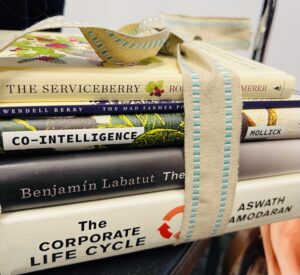
This year’s book list is not yet complete, but here are a few favorites recently shared with my team. With more to follow!
The Serviceberry, Robin Wall Kimmerer
The Mad Farmer Poems, Wendell Berry
Co-Intelligence, Ethan Mollick
The Corporate Life Cycle, Aswath Damodaran